In early childhood settings, Purim can easily become a day of costumes, noise, and sugar. And while joy and play absolutely belong, Purim also offers something deeper: a powerful opportunity to help children experience Jewish values, beyond just learning about the holiday.
The question isn’t simply, How do we celebrate Purim?
It’s: What do we want children to feel, practice, and remember?
When we approach Purim with intention, its themes can show up in both explicit ways (what we name and teach) and implicit ways (what children experience through environment, relationships, and choice). Together, these layers create meaning that lasts far beyond one day.
Hidden and Revealed
Purim is a story of things that are hidden and slowly revealed. Even Esther’s name comes from the Hebrew word for hiddenness.
Explicitly, we can talk with children about how some things are hard to see at first. We can read the Purim story with attention to moments of surprise and discovery, play games of peek-a-boo, and use language like, “Sometimes things hide, and sometimes everyone can see them!”
Courage and Standing Up
At its heart, Purim is also a story about courage. Esther steps forward even when she is afraid.
We can name this explicitly by using simple, empowering language: “Esther was brave,” or “Being brave doesn’t mean not being scared.” Role-playing moments of standing up for a friend helps children connect the story to their own lives and helps foster examples for social situations that arise in everyday life.
Identity and Transformation
Purim invites us to explore identity: Who am I? Who can I become?
Explicit conversations might include talking about costumes as “trying on” different roles, or inviting children to share why they chose a particular outfit. Books about self-expression and individuality deepen this exploration.
Implicitly, identity is honored when children are given freedom. Open-ended dress-up materials, the option to change costumes, or not wear one at all, send a powerful message: you can explore who you are, take risks and still be yourself at the end of the day.
Joy as a Jewish Value
Purim reminds us that joy itself is sacred.
We can name this explicitly by telling children, “On Purim, we celebrate joy,” singing silly songs, reading funny stories, and making noise with graggers..
Implicitly, joy shows up when celebrations are playful rather than performative. When educators follow children’s laughter, allow appropriate mess and noise, and prioritize connection over perfection, children learn that Judaism is a source of delight.
Community and Belonging
The Purim story teaches us that we are stronger together.
Explicitly, this can be highlighted through conversations about helping others, making mishloach manot as a class, and sharing how communities take care of one another.
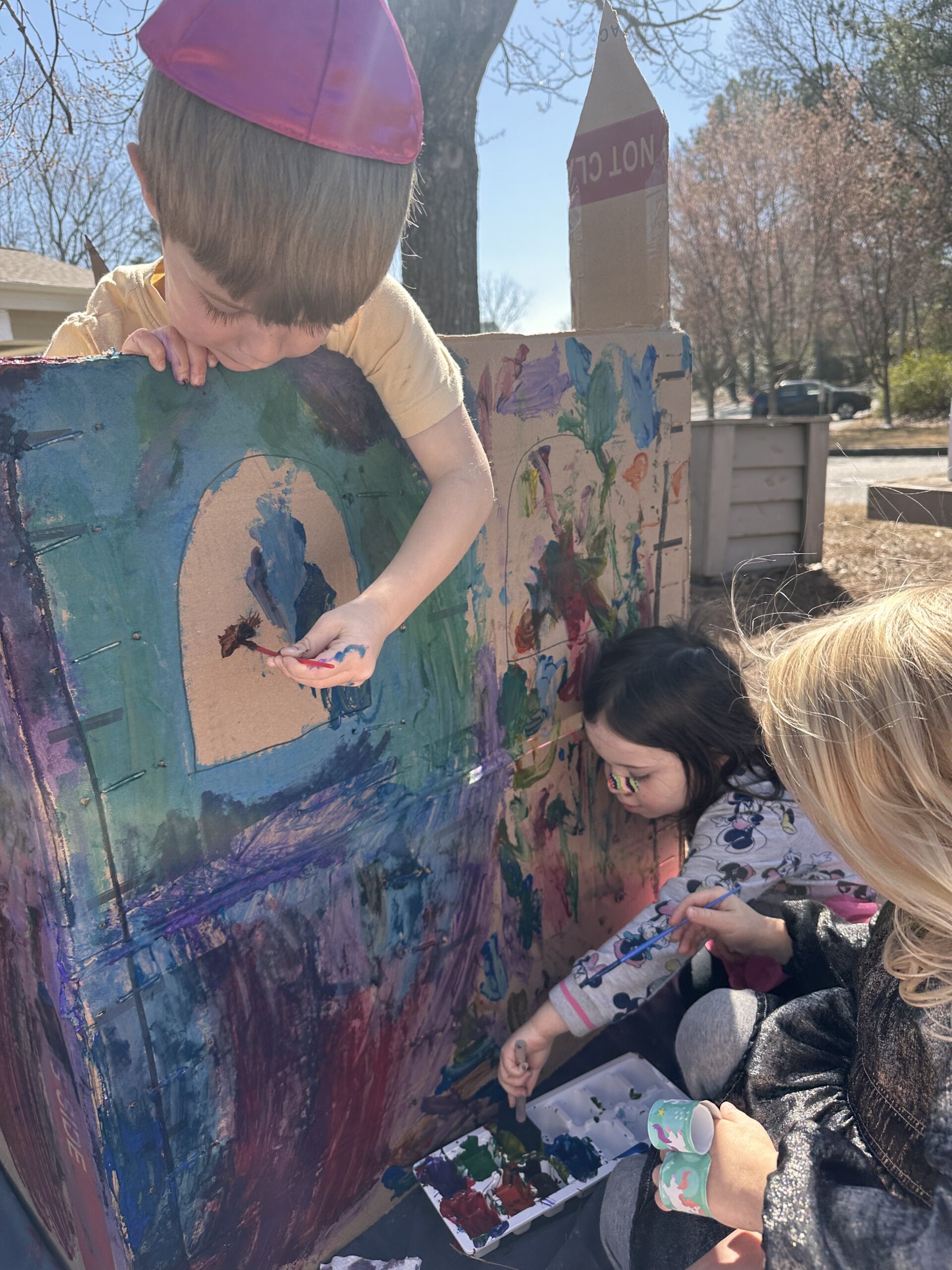
Implicitly, belonging is built through collaboration. Group art projects, shared clean-up, and opportunities for children to help one another communicate that each person matters and everyone has a role.
V’nahafoch Hu
One of Purim’s most powerful ideas is v’nahafoch hu, literally to turn upside down, but in our classrooms we can take that to mean that things can change.
We can name this explicitly by talking about how the story shifts from sadness to celebration, or how feelings can change over time.
Implicitly, this theme lives in flexibility. When children are encouraged to remix materials, rethink ideas, and notice changes in their environment or emotions, they experience hope and possibility firsthand.
Holding It All Together
When Purim themes are woven into classroom life both explicitly and implicitly, children don’t just learn about a holiday; they learn to live its values. They feel courage, joy, belonging, and agency in ways that are developmentally meaningful and deeply human.