Teaching Israel in the Age of Complexity: What Early Childhood Educators Are Saying Right Now
Across two sessions, ElevatEd brought early- career early childhood educators together to explore one of Jewish education’s most urgent challenges: How do we teach Israel to the youngest learners, honestly and with love?
Two weeks ago, dozens of early childhood Jewish educators from across the country gathered for a conversation that felt both timely and timeless about Israel education in early childhood classrooms.
What emerged offered a window into how Jewish early childhood educators are navigating one of the most complex moments in recent memory, and the power of an approach that begins with what teachers already know, believe, and carry with them.
Starting Point
Participants were asked to rate their comfort level teaching Israel to young children on a scale of 1–10. The responses were candid. Numbers clustered at the lower end: 1s, 2s, 3s there were a few outliers, including one Israeli educator who came in at a nine.
This discomfort wasn’t rooted in apathy. Educators spoke of caring deeply: about getting it right, about being fair, about not over- or under-explaining about something so complex and emotionally loaded to very young children.
One participant voiced what many were feeling: “I’m not Jewish, nor have I been to Israel. I’ve learned some things from my own research since we do an Israel trip inside the school every year, but I don’t feel comfortable teaching it on my own yet.”
Another was more direct: “Honestly, certain things we do not share with the children. I also know very little.”
The Paradigm Shift: Israel as a Living Place
A central thread in ElevatEd’s approach and the moment that seemed to resonate with participants was a simple realization: Why do so many schools teach Israel as if it’s a holiday, rather than a country?
The session invited educators to approach Israel as both a holy place and an ordinary on, a country where people commute, eat breakfast, argue about parking, send their kids to school. It has beaches and open-air markets, graffiti, snacks and music.
“I never realized how we ‘fictionalize’ Israel. It’s a real place with real people and rhythms.”— Session participant, afternoon cohort
By teaching Israel as a living, dynamic experience, rather than a uniform holiday, teachers can open new doors in the early childhood classroom. This type of teaching and learning feels alive and relevant for the early childhood educators who work with children who learn primarily through embodied, sensory experiences.
When participants were asked whether they experience Israel as “holy” or “home,” their responses opened up something deeper. Many gravitated toward one or the other—while others named that it lives somewhere in between.
This reflects what my research shows: educators from other faith backgrounds tend to describe Israel as a holy place, while Jewish educators more often relate to it as a home. Neither framing is wrong, but they communicate different ideas. When educators become aware of how they frame Israel, they can better understand how their perspective shapes what young children absorb as they begin forming their long-term relationship with Israel.
In sharing this with educators, I invited an opportunity for reflection: What messages are we sending, intentionally or not, when we talk about Israel with young children? How do our own relationships and assumptions shape what children come to understand?
For many in the room, educators aspired to teach in a way that encompassed the complexity of both home and holiness. However, they had not reflected upon how their language, curriculum and environment perpetuate the foundation of this duality.
Alongside these reflective conversations, the session grounded educators in practical, accessible ways to bring Israel into their classrooms—rooted in children’s everyday experiences. Educators explored how connections can grow through cooking and tasting foods, listening and moving to music, engaging with art, incorporating Hebrew language into daily routines, and building relationships with Israeli families and stories. These entry points are not just activities—they are intentional ways to help children begin to understand Israel as a place where people live full and varied lives.
Because ultimately, these conversations are not about landing in the “right” framing. They are about becoming more aware. In early childhood, the ways we speak—about people, places, and belonging—help lay the foundation for how children will come to understand connection, identity, and difference. And through both reflection and everyday practice, we can begin to offer children a picture of Israel that is rooted in humanity, diversity, and the richness of a multi-faceted society.
Educator Voices: What They’re Taking Back
By the session’s close, participants many of whom had started the hour uncertain, even a little lost were leaving with concrete ideas and a sense of permission. Here’s what they said, in their own words:
"I like the idea of a sensory approach: taste, touch, listening." — Participant, morning session
"I’m planning a picnic outside with a tasting of Israeli foods and music, weather permitting."— Kristin, morning session
"I have 12–22 month olds and they love cooking. Food is one of the easiest ways to teach it to babies."— Zoria, afternoon session
"Hebrew names on cubbies. Israeli foods in dramatic play. A real taste test."— Brianna C., morning session
"You made me realize how much I did actually know!"— Talia, morning session
"I want to lean on our families — we have a family from Israel who contributed recipes to our class cookbook."— MacKenzie, afternoon session
What Elevated’s Approach Makes Possible
These sessions illustrate something important about Elevated’s professional development model. This isn’t content delivery. It’s not a curriculum handed down from on high. It is an invitation — into curiosity, into honesty about discomfort, into the recognition that early childhood educators are doing some of the most consequential Jewish education work happening anywhere.
By grounding Israel education in what children already feel connected to, sensory experience, stories about families, food, music, the Hebrew language as something alive and present, Elevated gives educators both the framework and the permission to start where they are.
Looking Ahead
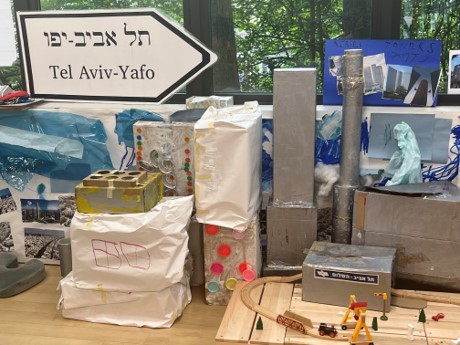
Yom Ha’atzmaut, Israel’s Independence Day, falls this year on the evening of April 21, 2026. Several schools represented in these sessions are already planning celebrations: simulated passport trips to Tel Aviv and the Western Wall, Israeli food tastings, blue-and-white dress days, and opportunities for children to experience Israel through music, movement, and play.
And alongside these joyful moments, something deeper is taking root.
“Some of the pressure was knocked off.” — What participants said when asked how they felt leaving the session.
That, perhaps, is the clearest measure of impact. Not a perfectly executed lesson plan, but a shift in how educators see themselves in the work. Not a curriculum or certainty, but courage and the willingness to keep asking questions, and to invite children into that wondering alongside them.
Because when educators feel less pressure to “get it right,” they create more space for what matters most: connection, curiosity, and care. And when Israel is introduced not only through celebrations, but through everyday life, through people, families, food, language, and story, children begin to build a relationship that is both meaningful and real.
This is not about simplifying Israel. It is about making it human.
And in early childhood, that is where foundation for all relationships begin.
To learn more about Elevated’s Israel education programming, contact:
sasha@elevatedtogether.org
Resources Shared in These Sessions
The session introduced educators to a rich landscape of materials for bringing Israel into early childhood classrooms: