Educators of Other Faiths in Jewish Early Chilhdood
Jewish early childhood education is more than a venue for transmitting tradition; it is one of the most powerful gateways families have into Jewish life, shaping long-term patterns of engagement and belonging. In these settings, educators influence how children and parents encounter Jewish values, ritual, and community in real time, often serving as their most consistent touchpoint with Jewish institutions. As centers increasingly rely on non-Jewish teachers, what this project calls educators of other faiths (EOFs), understanding what nurtures these educators’ professional identity and motivation has become a strategic priority for early childhood directors, institution executives, and communal leaders seeking to sustain vibrant Jewish early childhood programs.
My recent research offers insights that challenge conventional assumptions and invite a new vision for leadership and inclusion in Jewish early childhood settings. Drawing on a small case study of six educators of other faiths (EOFs) teaching in ElevatEd schools across the country, the findings reveal how these teachers, each self-identified as confident and competent Jewish educators, navigate their roles with purpose and authenticity. Their perspectives illuminate what it means to belong, teach, and lead within Jewish spaces, ultimately expanding how we understand who shapes Jewish learning today.
Why leaders should care about EOFs
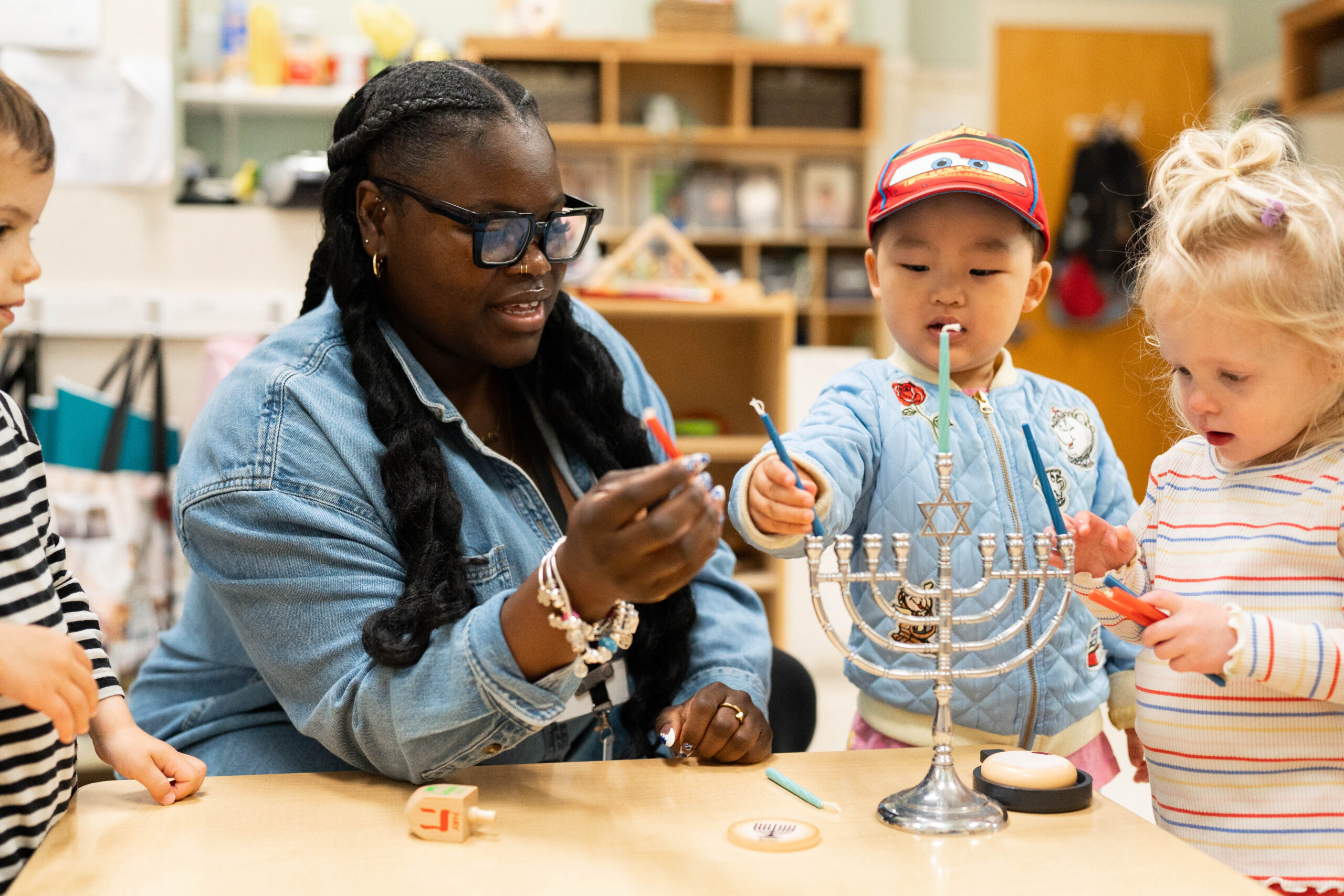
Across North America, Jewish early childhood centers are facing acute staffing challenges even as they shoulder enormous responsibility for welcoming families into Jewish life. Historically, most educators in these programs were themselves Jewish, but workforce shortages, low wages, and shifting demographics mean that a growing share of teachers now come from other faith and cultural backgrounds. Many of the most stable, talented teachers in these settings are EOFs, leading Shabbat circles, guiding families through their first Purim or Sukkot, and serving as trusted partners to parents, often without having grown up in Jewish communities themselves.
This research shows that EOFs can become deeply effective, motivated Jewish early childhood educators when certain conditions are in place, echoing broader findings about how supportive environments shape teacher identity and retention. Their stories point to five intertwined dynamics: pedagogical alignment, openness and curiosity, values-driven motivation, the productive use of outsider status, and the centrality of joy and belonging. Together, these findings offer a roadmap for leaders who want to both honor Jewish integrity and sustain a diverse, committed workforce in their centers.
Beyond Identity: The Power of Pedagogical Alignment
EOFs strengthen their professional identity when they work in settings where the pedagogy matches their beliefs about children and learning, often through Reggio-inspired, inquiry-based approaches that honor children as capable and curious and value collaboration, reflection, and exploration. Mary, a Reggio-inspired teacher, captured this alignment: “My teaching background has been primarily with Reggio-inspired schools. And that's very similar to how Jewish education... wants the children to ask questions, how you want to provide provocations and to get the children thinking... and then asking questions about them, and then leading to more, and building upon.” EOFs often prioritize this pedagogical fit over religious identity; when the educational approach resonates with their convictions, they describe a strong sense of agency, authenticity, and long-term commitment to Jewish early childhood settings.
Values driven: Shared commitments that transcend religion
EOFs’ professional identities are deeply rooted in values like community, kindness, respect, justice, and care for the world, that strongly overlap with core Jewish educational commitments. Even without a Jewish religious identity, they find real points of resonance with the ethos of their schools, which allows them to engage in Judaic curriculum authentically rather than reciting someone else’s lines.
Jill described the universality and intentionality of her work this way: “Jewish values aren't just for Jewish people... they're universal. Once it became my role to be the Jewish educator in the classroom, I became more intentional... How do the Jewish values guide me as a teacher? And how do I seek the Jewish moments in regular life?” Many EOFs connect their motivation to commitments like social justice, environmental stewardship, inclusion, and acceptance, and experience Jewish stories and practices about welcoming the stranger or repairing the world as familiar and meaningful rather than foreign. This fuels their sense of agency, competence, and belonging: they see themselves as advancing values they already hold deeply, through a Jewish language and framework they are learning to inhabit, which in turn sustains their commitment even in a chronically undercompensated field.
Outsider status: Liability, gift, and leadership opportunity
EOFs occupy a complex space: insiders in the daily life of the classroom but outsiders to the Jewish community’s religious and cultural core, a position that can shape both their professional identity and their impact. When supported well, this outsider status becomes a source of empathy, insight, and even leadership. Sierra reflects the journey from outsider to “honorary” insider: “I've been at my early childhood center for three years now... Everyone there has become my family. They call me their honorary Jew... I've done as much due diligence as possible to involve myself into a community that I wasn't a part of and hopefully am... respecting it along the way... I dove in. I didn't know anything, and I wanted to know it all.”
Because they know what it feels like not to “speak the language,” EOFs often bring particular sensitivity to new families, interfaith households, or anyone hovering on the edge of belonging, creating classrooms where questions are welcomed and traditions are explained rather than assumed. With mentoring and clear boundaries around what they can authentically lead, initially low expectations can become a growth engine: as EOFs demonstrate genuine curiosity and growing expertise, they exceed expectations, gain confidence and agency, and sometimes emerge as informal leaders or mentors to Jewish peers around pedagogy and inclusion, quietly expanding assumptions about who can be a “real” Jewish educator.
Joy and belonging: Emotional foundations for retention
This research underscores that joy and belonging are central to EOFs’ motivation and identity as Jewish early childhood educators, and both are closely tied to whether teachers choose to stay. Jewish early childhood settings are rich with ritual and celebration including Shabbat, holidays, and everyday blessings, that function as active, relational sites of meaning, connection, and pride.
Mary describes the impact of this joyful culture: “Honestly, my favorite part is how everything is so celebrated. There’s something special every week. We have Shabbat every week. We have a party every week. All the holidays are festive and fun. We make it so meaningful for everybody, for the children, for the teachers. It's fun, and it's purposeful.” When EOFs are invited into these moments as full participants, not just support staff in the background; they report a deepening sense of purpose and belonging that supports their well-being and long-term commitment.
Crucially, belonging does not require them to erase their own religious identity; inclusive practices that affirm who they are while welcoming them into Jewish rhythms enable a transformative weaving together of personal and professional selves. The interplay of joy, relationships, and values-rich practice allows EOFs to teach Judaic content with authenticity, creating classrooms that are distinctly Jewish and genuinely inclusive.
Agency and Autonomy: Building Confidence and Competence
Agency and autonomy are critical for educator growth. Staff, including EOFs, flourish when they're trusted to bring their own ideas and perspectives into the classroom.
While some directors feel compelled to closely oversee EOFs due to perceived gaps in Jewish subject knowledge, research shows autonomy and support, rather than micromanagement, foster motivation and professional fulfillment.
Kate puts it simply:
“If I have an idea, people on my teaching team say, ‘Okay, great, let's do it...’ We try not to create barriers for each other... It's motivating to try new and different things... makes the job way more fun.”
What leaders and policymakers can do
These findings point to clear action steps for directors, system leaders, and funders who want to support EOFs effectively and ethically.
Closing invitation to leaders
This research makes one thing clear: educators of other faiths are not a temporary stopgap in Jewish early childhood education. They are already central to how many families experience Jewish community, often embodying the very values, like curiosity, care, justice, and joy, that the community hopes to transmit to the next generation.
For directors, institutional leaders, and federation professionals, the invitation is to treat the formation and support of EOFs’ professional identities as core strategic work. By aligning pedagogy, nurturing curiosity, leading with values, honoring outsider status, and cultivating joy and belonging, communal leaders can build ECJE workplaces where diverse educators flourish, and where Jewish life in the classroom is both deeply rooted and expansively welcoming.